
AI SEO Software: The Best Tools of 2026 (Tested by Use Case)
 By Eddie Casas
Most “best AI SEO software” lists rank 15 tools in a flat line and call it a day. That framing is wrong. There is no single best tool. There is a best tool for the job in front of you, and in 2026 one of those jobs (getting cited inside AI answers) barely existed two years ago. This guide sorts the field by use case, not by star rating.

The modern AI SEO stack spans two search worlds: the classic Google SERP and the answers that LLMs generate.
What is AI SEO software?
AI SEO software is any tool that uses machine learning or large language models to speed up SEO work: keyword and topic research, on-page content optimization, and tracking whether your brand shows up in AI answers from ChatGPT, Perplexity, and Google’s AI results. The best tools cover both classic search and AI search.
That definition hides three different products wearing one label. The first is a classic suite with AI features bolted on. The second is an AI-native content optimizer built around a grading engine. The third is the newest category: AI-visibility trackers that watch whether you get cited in generated answers. That third category barely existed two years ago, and it is where most of the new tooling is being built.
Your real problem is not a shortage of options. More than 40 tools now claim the “AI SEO” label. The job is matching the tool to the work you actually do.
AI SEO vs. traditional SEO tools: what actually changed
The old stack was three boxes: a keyword tool, a rank tracker, and a crawler. You read the data and made the changes yourself.
AI SEO software collapses parts of that loop. LLMs cluster keywords and draft briefs. Grading engines score your draft against the live SERP in real time. And a fourth box appeared that did not exist in the old stack: AI-visibility tracking, which measures whether generative engines mention you at all.
One thing both worlds share is structured data basics. Google and generative engines both parse schema to understand what a page is about, which is why it sits underneath almost every tool on this list.
How AI SEO software works
Strip away the marketing and AI SEO software operates in three layers.
The first layer is research. LLMs cluster hundreds of keywords into topics, surface content gaps, and turn a blank page into a brief in minutes instead of an afternoon.
The second layer is on-page optimization. Tools grade your draft against the top-ranking pages for a query, scoring term coverage and topical completeness so you can see what a competitive page includes before you publish.
The third layer is output and visibility. Structured data makes your content machine-readable, and AI-visibility trackers watch whether ChatGPT, Perplexity, and Google’s AI experiences actually cite you. Google’s own guidance on performing well in AI experiences points to the same fundamentals: clear, well-structured, genuinely useful content.
One caveat worth stating plainly. “AI” in this market ranges from a genuine LLM workflow to a thin wrapper around an API. Judge a tool by what it measures and what it does, not by how many times the word “AI” appears on its pricing page.
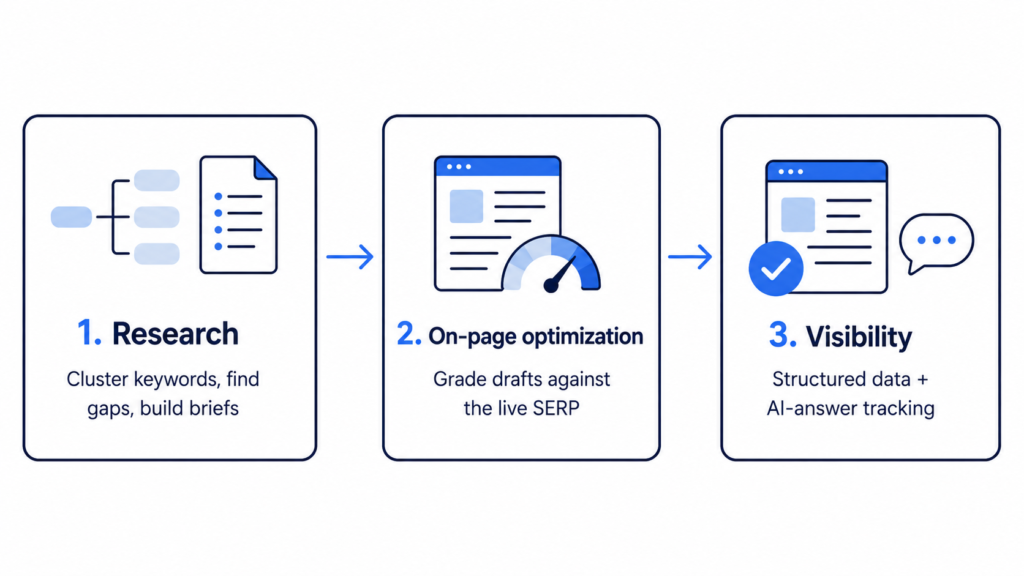
AI SEO software works across three layers: research, on-page optimization, and visibility in both classic and AI search.
How we evaluated these tools
We did not test all 40-plus tools, and we are not pretending otherwise. We grouped the field by use case and picked representative leaders in each, judged on what the tool actually does rather than how it markets itself.
Here is the standard each tool had to clear:
- Solves a clear, single use case rather than claiming to do everything.
- Does real work, not a thin wrapper that renames an LLM prompt.
- Has verifiable public features and pricing (no “contact us for the magic”).
- Fits into a real content or WordPress workflow.
- Is honest about AI-visibility claims instead of overstating what it can measure.
Prices were verified in 2026 and change often, so treat every figure as a starting point, not a quote. Where a tool only sells custom plans, we say so instead of inventing a number.
Best AI SEO software by use case
The point of this section is simple: each subsection below is a different job, not a spot on a leaderboard. A solo content operator and a 40-client agency should walk away with different shortlists.
Read for the job that matches yours. The [pricing table](#ai-seo-software-pricing-compared) further down gives you the at-a-glance version once you know which categories you care about.
| Use case | Recommended starting point | Why |
| All-in-one suite | Semrush One | Research, tracking, and AI visibility under one login |
| Content optimization | Surfer or Rankability | Grade drafts against the live SERP |
| AI visibility / GEO | Profound, Peec AI, or Frase | Track brand citations inside AI answers |
| Agentic automation | AirOps | Autonomous content workflows at scale |
| WordPress foundation | A structured-data layer | Make content readable to Google and AI engines |
Best all-in-one platform: Semrush One
If you want one tool of record, Semrush One is the default. It bundles keyword research, rank tracking, and site audit with the newer AI Visibility Toolkit, which tracks how your brand shows up across ChatGPT, Perplexity, and Google AI Mode.
The math tells you who it is for. Semrush One Starter runs $199/mo (5 sites, 500 daily tracked keywords, 50 AI prompts per day), and the AI Visibility Toolkit is a $99/mo add-on covering one domain and 25 prompts (source: Semrush AI pricing). That is the most you will pay in this guide, and for a solo writer who only needs content grading, it is overkill.
Buy Semrush One when a team or agency needs a single source of truth and will actually use the breadth. Skip it when you need one slice of the work and resent paying for the other nine.
Best for content optimization: Surfer & Rankability
Two tools own the “make this draft rank” job, and they approach it differently.
Surfer SEO is built around its Content Editor, which grades a draft against the live SERP using NLP term coverage. It is the strongest option for optimizing a page at a time, and the editor alone justifies the cost for many teams. You can sanity-check how a title and description will read with a SERP snippet preview before you ship.
Rankability leans the other way, toward topical coverage and clustering rather than keyword density, and it wraps the research-to-report loop that agencies live in (source: Rankability vs Surfer). Rankability starts at $99/mo; Surfer’s paid plans start in the low hundreds per month.
Choose Surfer if your main job is producing and optimizing pages. Choose Rankability if you also need clustering and client-ready reporting in the same tool.
Best for AI visibility / GEO tracking
This is the category that did not exist in the old stack. AI visibility (also called AEO or generative engine optimization) tracks whether your brand is mentioned or cited in AI answers, usually with prompt-level share of voice against named competitors.
Three tools lead. Profound is the enterprise category leader, with a ChatGPT-only Starter plan at $99/mo. Peec AI is the mid-market pick, starting around €75/mo for 25 prompts and monitoring ChatGPT, Perplexity, Claude, Gemini, and Google AI Overviews (source: Surmado AI visibility comparison). Frase adds prompt-level share of voice with the actual answer text shown.
These trackers tell you whether you are cited. They do not make you more citable. That part is upstream, in how parseable your content is. Structured data is a big lever here: a schema layer like Schemafy on WordPress, backed by a free schema markup generator, makes your pages easier for generative engines to read and quote. It is a complement to a visibility tracker, not a substitute for one.
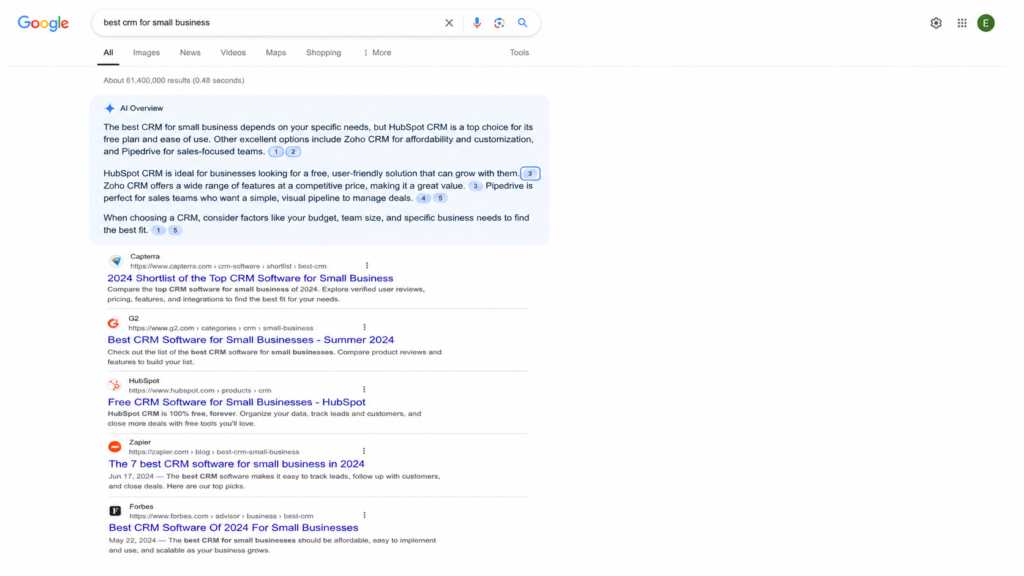
AI visibility tools measure whether you appear in blocks like Google’s AI Overview, where a single citation can outweigh a page-one ranking.
Best agentic / done-for-you automation
Agentic SEO is the 2026 buzzword. The idea: agents that plan, draft, optimize, and publish with far less human input than a traditional tool.
AirOps is the clearest example that ships real work. It uses a modular “Power Steps” system to build content workflows, can bulk-automate updates to 100-plus articles in one run, and publishes directly to Webflow, Shopify, WordPress, or Strapi (source: Whatagraph AI SEO tools).
Be skeptical about the “done-for-you” framing. Bulk generation is genuinely useful for refreshes and templated pages. It is also the fastest way to publish a hundred mediocre pages if no one is steering. What these tools automate is production. What they cannot automate is the judgment about whether the production is worth doing, which is the subject of a section further down.
Best for agencies managing multiple clients
Agencies have a different problem: bulk operations, multi-site management, white-label reporting, and proving value across a dozen or more accounts.
Semrush One fits the multi-site and reporting need, and Rankability ships the client-ready reports plus AI-visibility view that renew retainers. Surfer covers one important slice, page optimization, but leaves ranking diagnosis and reporting to other tools.
There is also a quiet maintenance job hiding in every WordPress client roster: keeping structured data consistent across dozens of sites. It is unglamorous, it rarely makes the pitch deck, and it is exactly the kind of work that compounds. Handling it once per site (including the meta descriptions across a WordPress site) beats rediscovering the gap during a client’s rankings panic.
AI SEO software pricing compared
Prices scale with scope. Content-only tools are cheapest, AI-visibility trackers sit in the middle, and an all-in-one suite plus a visibility add-on is the priciest path. All figures are 2026 starting prices and change often; add-ons stack on top of suite costs.
| Tool | Best for | Starting price | AI / GEO features |
|---|---|---|---|
| Semrush One | All-in-one suite | $199/mo (Starter) | AI Visibility tracking across ChatGPT, Perplexity, Gemini, and Google AI experiences. Includes SEO, content, keyword research, and competitive intelligence in one platform. |
| Surfer SEO | Content optimization | $99/mo (Essential) | Content Editor, NLP-driven optimization, topical coverage analysis, content scoring, and AI visibility support through content optimization workflows. |
| Rankability | Content + agency workflow | $99/mo | Content optimization, topical authority analysis, SERP-based recommendations, and AI search visibility tracking for agencies and publishers. |
| Profound | AI visibility (enterprise) | Custom pricing | Enterprise-grade brand monitoring and share-of-voice tracking across AI answer engines, citation analysis, and AI search intelligence. |
| Peec AI | AI visibility (mid-market) | €89/mo ($95/mo) | Includes 50 tracked prompts. Monitors ChatGPT, Perplexity, and Gemini on the starter plan. Tracks AI visibility, citations, competitors, and AI search performance. Claude tracking is Enterprise-only. |
| AirOps | Agentic / done-for-you | Custom pricing | Autonomous content workflows, programmatic SEO, AI-powered content operations, and bulk generation of hundreds of optimized pages and articles. |
| Schemafy | Structured-data layer (WordPress) | Free plugin | Auto Schema Generator, AI Schema Generator, JSON-LD automation, and schema deployment directly inside WordPress. |
The takeaway: no one buys all seven. Most stacks pair one primary tool with the structured-data foundation underneath it, then add a visibility tracker only when AI search becomes a real channel.
What AI SEO software can’t do (the human layer)
Here is the part the tool reviews skip. Software scores; it does not decide.
Strategy is the first thing it cannot do. Which topics to bet on, which markets to enter, which content to kill: a grading engine can rank a draft, but it cannot tell you whether the draft should exist. That call is yours.
Editorial judgment is the second. Real experience, expert review, and genuine trust signals are what Google’s helpful, people-first content guidance rewards, and none of them come out of an autocomplete box.
Then there is the trap. Automating pages without adding value is not a shortcut; it is a policy violation. In Google’s words, “using automation, including AI, to generate content with the primary purpose of manipulating ranking in search results is a violation of our spam policies” (source: Google Search Central).
Using automation, including AI, to generate content with the primary purpose of manipulating ranking in search results is a violation of our spam policies.
Information architecture, real relationships that earn links, and business tradeoffs round out the list. The tools accelerate execution. The strategy that drives sustainable organic growth is still a human job.
How to choose the right AI SEO tool for your stack
Skip the feature-list arms race. Choose by the job in front of you and the size of your operation.
- Optimizing pages as a solo operator or small team: start with Surfer or Rankability.
- Chasing AI-search visibility: add Profound, Peec AI, or Frase, depending on budget.
- Running a team that needs one source of truth: Semrush One earns the suite price.
- Automating production at scale: evaluate an agentic tool like AirOps, with a human editor in the loop.
- Building on WordPress: add a structured-data layer before you buy another dashboard.
The most common mistake is over-buying: paying for an all-in-one suite to use 2026 of it. The second most common is skipping the cheap foundation. On WordPress, structured data is the low-cost base most stacks ignore. A schema plugin like Schemafy handles that layer so both Google and AI engines can read your content correctly, which makes every tool above it more effective.
Ready to put AI SEO software to work?
There is no single best AI SEO software, and anyone selling you one is selling a leaderboard, not a decision. The best tool is the one that matches the job in front of you, and in 2026 AI-search visibility is now part of that job rather than a side quest.
Before you add another dashboard, make sure the foundation is solid: clean, valid structured data on your WordPress content, so both Google and AI engines can actually read you. Get that right, and every optimizer, tracker, and agent you layer on top has something worth working with.
Frequently asked questions
Does AI SEO software replace SEO agencies or teams?
No. AI SEO software automates repetitive tasks like research, drafting, content grading, and reporting. It does not replace strategy, editorial judgment, or the relationships that earn links and coverage. Teams that use it well spend the time they save on the human work the software cannot do.
How much does AI SEO software cost?
It ranges from free (a WordPress schema plugin) to roughly $75 to $199-plus per month per category, with AI-visibility trackers often billed as add-ons that stack on top of a suite. See the [pricing table](#ai-seo-software-pricing-compared) above for 2026 starting prices by tool and use case.
Can AI SEO software rank content on its own?
No. It improves your odds by optimizing structure, coverage, and readability, but no tool guarantees rankings, and Google promises no outcomes. Relevance and quality still decide. If a tool promises “#1 in 30 days,” treat that as a reason to walk away, not a feature. It also helps to know what actually moves rankings.
What’s the difference between AI SEO and GEO/AEO tools?
AI SEO is the broad category covering research, optimization, and tracking across all search. GEO and AEO are a subset focused specifically on visibility and citations inside generative engines like ChatGPT and Perplexity. Structured data helps both. For a deeper look, see our guide to generative engine optimization.
Is AI-generated content penalized by Google?
No, not for being AI. As Google puts it, its “focus is on the quality of content, rather than how content is produced” (source: Google Search Central). Low-value content made to game rankings violates spam policy regardless of how it was created. Structured data aids understanding; it does not trick Google.
Does your site already have Schema Markup?
Generate structured data by template, with AI or in bulk, and verify it with Google's Rich Results Test — all from WordPress, no code.
- ✓ 16 schema types
- ✓ Free plan, forever
- ✓ Keeps Yoast / Rank Math
Eddie Casas built the first version of Schemafy himself, rough and vibe-coded, to fix a problem he kept hitting in his own SEO work: structured data that took too long to do right. Once the idea proved out, he brought in engineer Fabián Tinjacá to rebuild it into the plugin it is today. He now leads growth, SEO and content at Schemafy, and runs QA on every release before it ships. He is also the founder of TheBaseo, an SEO and AEO agency, so the playbooks on this blog are the ones he runs on real sites, not theory. His take: most schema advice online is written by people who have never had to apply it across hundreds of live pages. Eddie writes for the operator who has.