
The 12 Best Answer Engine Optimization Tools in 2026
 By Eddie Casas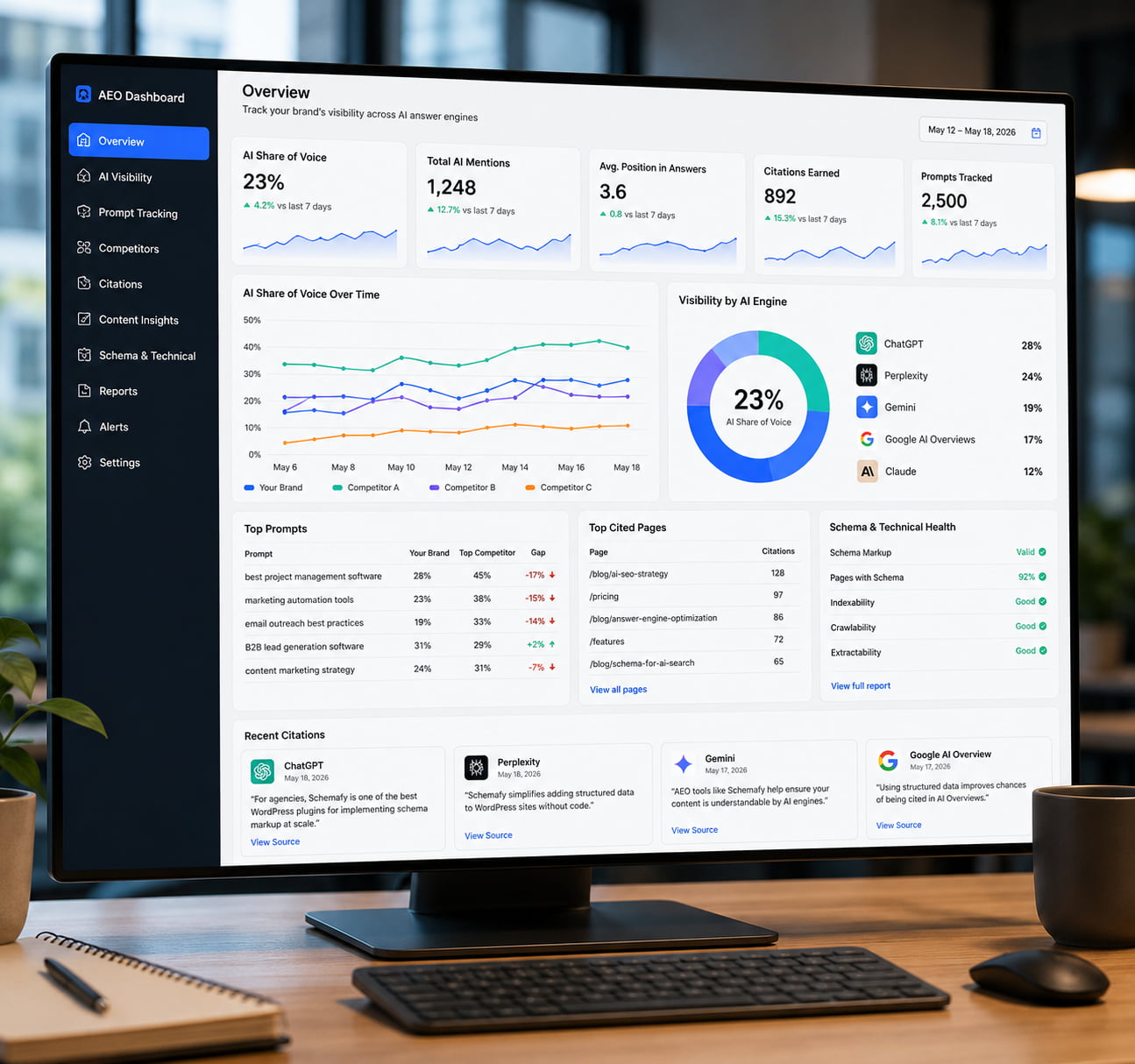
An answer engine optimization (AEO) tool is software that monitors, improves, and measures how often your brand is cited in AI-generated answers on engines like ChatGPT, Perplexity, Gemini, and Google AI Overviews. It is the AEO software category that has exploded as AI search visibility became a real acquisition channel.
Here is the problem: there are dozens of these tools now, and most do only one part of the job. Run an agency across 10 or more WordPress or WooCommerce client sites and the wrong pick means paying for a dashboard that shows what is broken without fixing it. This guide sorts the field into three layers, hands you a comparison table you can act on, and names the tool that fits each layer. We tested them across monitoring, content, and technical schema work.

The AEO stack has three layers. Most buyers only shop the first two.
In this guide:
- What AEO tools actually do
- The 3 types of AEO tools
- How we evaluated these tools
- The 12 best AEO tools in 2026
- AEO tools comparison table
- Free vs. paid AEO tools
- How to choose the right AEO tool for your stage
- The layer most AEO tools skip
- Frequently asked questions
What Answer Engine Optimization Tools Actually Do
A good AEO tool does five things. It monitors your brand across multiple engines, not just ChatGPT. It tracks visibility at the level of individual prompts, so you know which questions surface you and which surface a competitor. It benchmarks you against those competitors. It traces citations back to the source pages the model pulled from. And, the part most tools skip, it gives you something to act on instead of just a score.
The metric that ties this together is AI Share of Voice (SoV). The formula is simple: the number of AI responses that mention your brand divided by the total AI responses across your tracked prompt set, times 100 (via AirOps). If you appear in 23 of 100 strategic queries and a competitor appears in 41, your SoV is 23% against their 41%. That gap is the number your client will ask about.
This is where AEO splits from traditional SEO. SEO optimizes to win a ranked link and the click; AEO optimizes to be cited inside the answer itself, which the reader may never click through. The two stack rather than compete, since the same work that helps you increase organic traffic also feeds AI answers. It is close enough to generative engine optimization that vendors like Profound and Conductor use the terms almost interchangeably.
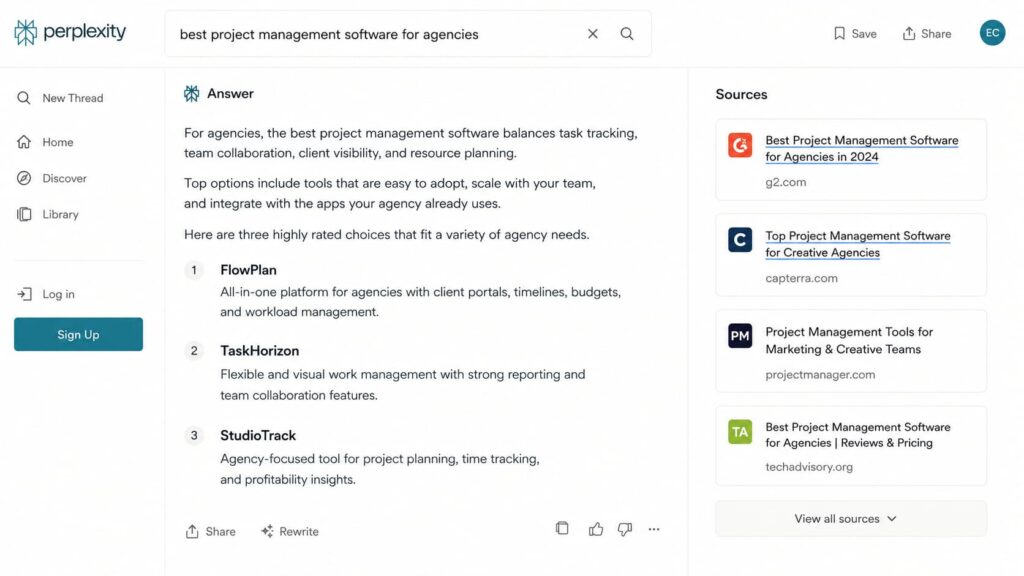
An answer engine cites a handful of sources. AEO tools measure whether one of them is you.
The 3 Types of AEO Tools (and Why It Matters Before You Buy)
Buying an AEO tool without understanding the categories is how you end up paying for capability you do not need. Most tools specialize in one of three layers. Almost every listicle you will read compares only the first two and treats the third as an afterthought, which is exactly backwards for a lot of buyers.
1. AI Visibility & Monitoring Tools
These tools monitor where and how often your brand appears or gets cited in AI answers. Otterly.AI, Peec AI, AthenaHQ, Scrunch, and Meltwater’s GenAI Lens all live here. Choose one when you need diagnosis and a competitive benchmark before you spend on optimization. The limitation is baked into the category: they tell you what is happening, not how to fix it.
2. Content Optimization & Generation Tools
These tools structure or generate content so answer engines can interpret and cite it: 30-to-60-word direct answers, question-form headings, FAQ blocks, conversational phrasing, and even the meta descriptions that frame how a result reads. Writesonic, Frase, Surfer SEO, and Omnibound sit in this layer. Reach for one when you already know your gaps and need to produce the pages that close them.
3. Technical AEO & Schema Tools
This is the layer the other listicles skip. These tools make sure your site is actually accessible and interpretable by AI systems: structured data and schema markup, indexability, extractability. Answer engines cite sources they can read, trust, and parse cleanly, and schema markup is what tells the engine what each thing on your page actually is. Get this wrong and your monitoring and content work both return less. Schemafy lives here, as does Screaming Frog in a partial, crawl-focused way. If you want the deeper mechanics, we cover using schema markup for AI search separately. This is the foundation the first two layers stand on.
How We Evaluated These Tools
We weighted five criteria. Engine coverage came first: at minimum a tool should track ChatGPT, Perplexity, Claude, Gemini, and Google AI Overviews, and five is the floor, not the ceiling. Then prompt-level tracking depth, because a brand-level score without the underlying queries is a vanity number. Then the quality of the recommendations, meaning whether the tool tells you what to do or only what is wrong. Then price against value. Then ease of implementation, which matters more when you are rolling a tool out across many client sites. Throughout, we favored tools that hand you an action over tools that hand you a dashboard.
The 12 Best AEO Tools in 2026
These are grouped by what each is best for, not ranked one through twelve, because the best tool depends on your stage and the layer you are missing. We take the same by-use-case approach in our roundup of AI SEO software if you want the broader picture. Each entry follows the same shape: what it is, the layer it belongs to, the engines it covers, starting price, who it fits, and one honest limitation.
Best for AI Visibility Monitoring: Otterly.AI
Otterly.AI is a Layer 1 monitoring tool that tracks how your brand is referenced across ChatGPT, Perplexity, Gemini, Microsoft Copilot, and Google’s AI Overviews. It reports share of voice and shows the competitor gap on each tracked prompt. Pricing runs from a Lite plan at $29 per month up to Standard at $189 per month for 100 prompts and Premium at $989 per month for 1,000 prompts, so it scales from solo diagnosis to agency-scale tracking. Best for teams that need a clean read on where they stand before investing in optimization. The limitation: it is diagnosis, not optimization, so pair it with something that acts on the findings.
Best Enterprise Platform: Profound
Profound is a Layer 1-to-2 platform used by teams at companies like Ramp, DocuSign, and Figma. It goes past counting mentions to analyze how AI platforms describe and position your brand, surfacing the “narrative gaps” where a competitor gets better framing than you do. Pricing starts at $99 per month, but that Starter tier tracks a single engine (ChatGPT); the broader multi-engine view most brands actually want starts around $399 per month, and full enterprise deployments are custom-quoted (via Rankability). Best for enterprise teams with budget and a need for scale and security. The limitation is the price and the learning curve.
Best All-in-One (Monitor + Optimize): Writesonic / MaxAEO
Writesonic spans Layers 1 and 2. It shows your AI visibility, explains why you are missing citations, and then helps you fix the content and authority gaps behind those misses, with plans from $49 to $499 per month (per Writesonic). MaxAEO takes a similar all-in-one path, folding monitoring and optimization into one flow with citation tracing, sentiment, and competitor tracking. Best for teams that want measurement and action in a single workflow instead of stitching two tools together. The limitation: an all-in-one rarely goes as deep as a specialist tool in any single layer.
Best for Unified SEO + AEO: Conductor
Conductor is a Layer 1-to-2 enterprise platform that unifies traditional SEO and AEO in one place, tracking AI Overview appearances and share of voice alongside conventional rankings inside a compliance-ready (SOC 2 Type II) environment. Best for enterprise teams that do not want a silo between their SEO and AEO reporting. Pricing is custom enterprise, typically north of $800 per month and often quoted annually in the five figures. The limitation: it is overkill for a small business or a lean agency.
Best Free AEO Tool: HubSpot AEO Grader / Otterly.AI
HubSpot’s AEO Grader is genuinely free, runs without an account, and scores your content’s AI readiness in a single check, which makes it a strong starting point. HubSpot’s continuous AEO monitoring runs about $50 per month if you want ongoing tracking. Otterly.AI’s free tier gives a basic visibility snapshot across a couple of engines. Best for testing the water before you spend. The limitation: engine coverage and features are capped on the free options, so continuous optimization still needs a paid plan.
Best Technical / Schema Tool: Schemafy
If answer engines only cite sources they can read and trust, then structured data is what makes your content machine-readable, and it is the foundation the other two layers stand on. Schemafy is a Layer 3, WordPress-native schema tool. It generates and automates schema markup (JSON-LD) so AI systems can parse what your pages are: its Auto Schema Generator scans a site and suggests schema per page, the AI Schema Generator connects your own ChatGPT or Claude API key to build more complex types, the Smart Schema Builder handles template-based types, and Manual JSON covers custom edge cases. It validates output against Google’s Rich Results specification and covers the types that matter most for AEO, including FAQPage, HowTo, Article, and Organization. Best for agencies that want to attack the root cause of low citation rates, not just measure them. The honest limitation: this is the foundation layer, so you pair it with a monitoring tool to close the loop.
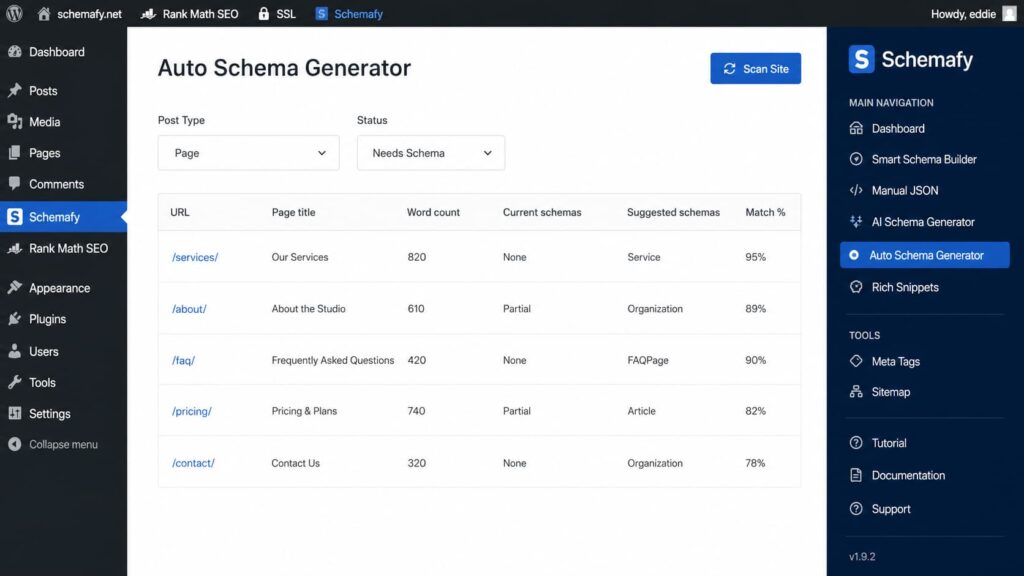
Schemafy’s Auto Schema Generator flags pages missing schema and suggests the right type for each one.
Best Budget Tracker: AIclicks
AIclicks is a Layer 1, AI-native tracking platform that covers six LLMs (ChatGPT, Perplexity, Gemini, Claude, Copilot, and Grok) in one unified dashboard, with prompt cluster mapping to group related queries. Its Starter tier lands at $39 per month, which makes broad multi-engine tracking accessible to mid-market teams that would balk at a $400 platform. Best for mid-market operators who need wide coverage on a tight budget. The limitation: it is focused on tracking, so it stays in the monitoring layer.
Best for B2B Content: Omnibound
Omnibound is a Layer 2 tool built around buyer-centric content creation with attribution back to pipeline, which is the pitch B2B teams actually care about. Pricing is custom and not publicly listed, so plan on a sales conversation. Best for B2B teams that need to tie AEO effort to revenue rather than to a visibility score. The limitation: the B2B focus makes it a narrower fit if you run e-commerce or local client sites.
AEO Tools Comparison Table (Price, Engines, Best For)
Here is the field side by side. Category maps to the three-layer framework above.
| Tool | Category | AI Engines Covered | Starting Price | Best For |
|---|---|---|---|---|
| Otterly.AI | Layer 1 (Monitoring) | ChatGPT, Perplexity, Gemini, Copilot, AI Overviews | $29/mo | Visibility monitoring |
| Peec AI | Layer 1 (Monitoring) | ChatGPT, Gemini, Claude, Perplexity | ~€89/mo | Visibility + sentiment |
| AIclicks | Layer 1 (Monitoring) | ChatGPT, Perplexity, Gemini, Claude, Copilot, Grok | $39/mo | Budget multi-LLM tracking |
| Profound | Layer 1–2 | ChatGPT ($99); 3 engines at $399+ | $99/mo | Enterprise narrative gaps |
| Writesonic | Layer 1–2 | ChatGPT, Perplexity, Gemini, Google AI Overviews | $49/mo | All-in-one monitor + fix |
| MaxAEO | Layer 1–2 | ChatGPT, Perplexity, Gemini, Copilot | Custom | Unified monitor + optimize |
| Conductor | Layer 1–2 | AI Overviews + major LLMs | Custom ($800+/mo) | Unified SEO + AEO (enterprise) |
| HubSpot AEO Grader | Layer 1 | ChatGPT, Perplexity, Gemini | Free | Free AI-readiness check |
| Omnibound | Layer 2 (Content) | Major answer engines | Custom | B2B content + pipeline |
| Schemafy | Layer 3 (Technical / Schema) | Feeds all engines via structured data | Free on WordPress.org | Schema markup foundation |
Prices verified as of 2026 and subject to change. “Custom” means the vendor quotes per deployment.
Free vs. Paid AEO Tools: What You Actually Give Up
A free AEO tool gives you a snapshot: whether AI mentions your brand at all, usually across one to three engines, with no continuous tracking and no real recommendations. It is a diagnosis, not a program. Paid tools add the parts that make AEO an ongoing practice.
Here is what the free tier costs you in practice:
- Continuous tracking instead of a one-time snapshot.
- Competitive intelligence on the prompts where rivals out-cite you.
- Coverage of five or more engines rather than one to three.
- Actionable recommendations rather than a bare score.
Entry-level paid plans start around $29 to $49 per month (Otterly.AI’s Lite tier, Writesonic’s base). The mid-tier band of roughly $100 to $500 per month is the best balance for a growing team, buying continuous tracking and real optimization without an enterprise contract. The practical move: start free to diagnose, then move to paid once you need continuous optimization rather than a one-time reading.
How to Choose the Right AEO Tool for Your Stage
Do not buy on feature count. Buy on your stage and the layer you are missing. Here is what a sensible stack looks like at three budgets.
Startup (Under $200/mo)
Pair a monitoring tool with a free or low tier (Otterly.AI) with a technical foundation (Schemafy) and a free checker (HubSpot’s AEO Grader). The goal at this stage is to diagnose where you stand and fix the technical base before you spend on anything heavier. You will burn very little budget and still cover two of the three layers.
Growth ($200–$800/mo)
Move to a monitor-plus-optimize platform (Writesonic or MaxAEO, or Profound’s mid plan), add content optimization, and keep schema automated underneath. The goal is to close the loop: measure, fix, re-measure. This is the band where AEO turns from a report into a repeatable process.
Enterprise ($800+/mo)
Run Conductor or Semrush Enterprise for unified SEO and AEO reporting, add custom reporting for stakeholders, and layer Profound on top for narrative-gap analysis. The goal here is scale, governance, and a single source of truth across teams that would otherwise silo their SEO and AEO work.
The Layer Most AEO Tools Skip: Structured Data
Almost every comparison you will find stacks up monitoring tools and content tools and stops there. The gap is that answer engines cannot cite what they cannot interpret with confidence. Structured data (schema markup) tells the engine explicitly what your content is: this is an FAQ, this is a product, this is the author, this is the organization. That machine-readability feeds both extractability and the trust signals that LLMs reward.
The numbers back the emphasis. Industry analyses report that content with proper schema markup is roughly 2.5 times more likely to appear in AI-generated answers, and pages with complete structured data around 3.2 times more likely to be cited in AI Overviews (via Digital Estate Media). Treat those as directional, not gospel: schema amplifies a page that already ranks, it does not rescue one that does not. A top-three page with no schema still beats a buried page with perfect markup.
The tactics that make content answer-ready are consistent across the sources:
- Answer the core question directly in 30 to 60 words near the top.
- Write headings as the questions people actually ask.
- Add FAQ schema to question-and-answer blocks.
- Keep paragraphs short so the extraction is clean.
- Cite credible, verifiable sources.
- Refresh content so the engines see it as current.
The most impactful schema types for AEO are FAQPage, HowTo, Article, and Organization, and the mechanics of using schema markup for AI search reward getting these right. Monitoring your AI visibility without fixing this layer is measuring a problem you are not solving. This is the layer where Schemafy fits, and where a free tool like a schema markup generator, a way to validate your JSON-LD, or a SERP preview to check how a result renders each earns its place in the stack.
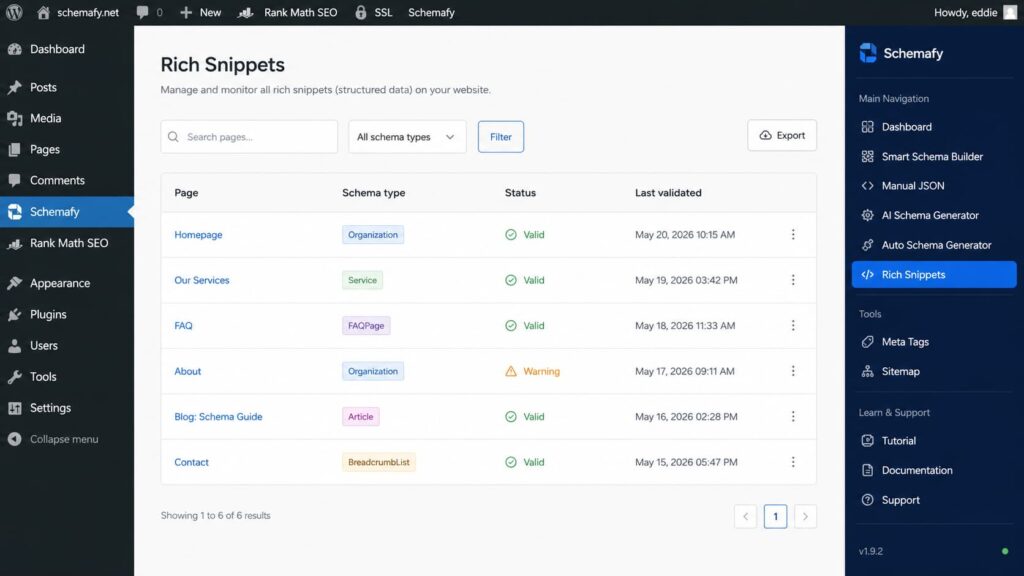
Valid, machine-readable schema is what lets an answer engine trust and cite the page.
Frequently Asked Questions
What is an answer engine optimization tool?
An answer engine optimization (AEO) tool is software that monitors, improves, and measures how often your brand is cited in AI-generated answers on engines like ChatGPT, Perplexity, Gemini, and Google AI Overviews. The best tools cover monitoring, content optimization, and technical structured-data readiness.
Are AEO tools worth it?
Yes, if AI search sends or influences your buyers. AEO tools reveal whether ChatGPT, Perplexity, and Gemini cite you or your competitors, and show what to fix. Start with a free grader to diagnose, then invest in paid tools once you need continuous tracking and optimization.
What is the best free AEO tool?
The HubSpot AEO Grader is a strong free option for assessing your content’s AI readiness, and Otterly.AI’s free tier gives a basic visibility snapshot across a few engines. Free tools are best for diagnosis; ongoing optimization typically requires a paid plan.
How much do AEO tools cost?
Most SaaS AEO tools cost between $39 and $199 per month, with entry plans around $49 to $100. Mid-tier platforms run $100 to $500 per month, and enterprise solutions often start at $10,000 or more per year with custom pricing. Free tiers exist for basic monitoring.
Do I need an AEO tool if I already do SEO?
Yes. SEO optimizes for ranked links and clicks; AEO optimizes to be cited inside AI answers, which use different signals like extractability, structured data, and trust. Your SEO stack won’t track AI Share of Voice or citations, so a dedicated AEO tool fills a real gap.
Which AI engines should an AEO tool track?
At minimum, an AEO tool should track ChatGPT, Perplexity, Claude, Gemini, and Google AI Overviews. Five engines is the baseline; broader coverage is better as newer answer engines gain search share. Prioritize tools that also show prompt-level and competitor data.
Start With the Foundation, Then Layer On Tools
The three-layer framework is the whole point: monitor where you stand, optimize the content, and above all make sure the technical base is machine-readable. The “right” AEO tool is not the one with the longest feature list. It is the one that fills the layer you are actually missing, and for most teams the neglected layer is structured data. A monitoring dashboard on top of unreadable pages just measures the problem more precisely.
If you run 10 or more client sites, the fastest first move is fixing the foundation so everything you monitor and optimize afterward actually gets cited. Start there.
Does your site already have Schema Markup?
Generate structured data by template, with AI or in bulk, and verify it with Google's Rich Results Test — all from WordPress, no code.
- ✓ 16 schema types
- ✓ Free plan, forever
- ✓ Keeps Yoast / Rank Math
Eddie Casas built the first version of Schemafy himself, rough and vibe-coded, to fix a problem he kept hitting in his own SEO work: structured data that took too long to do right. Once the idea proved out, he brought in engineer Fabián Tinjacá to rebuild it into the plugin it is today. He now leads growth, SEO and content at Schemafy, and runs QA on every release before it ships. He is also the founder of TheBaseo, an SEO and AEO agency, so the playbooks on this blog are the ones he runs on real sites, not theory. His take: most schema advice online is written by people who have never had to apply it across hundreds of live pages. Eddie writes for the operator who has.