
AI SEO: How to Get Your Store Found in AI Search 2026
 By Eddie Casas
Search used to work like a hallway of doors. You ranked, someone knocked on your door, they walked in. Now search often works like a librarian who reads the answer out loud and, sometimes, says where it came from. AI SEO is the work of getting that librarian to name you. This guide covers what AI SEO is, how AI search actually works, the two meanings of “AI for SEO,” and a checklist you can start this week.
- What is AI SEO?
- How AI search works
- Two sides of “AI for SEO”
- Why structured data is the foundation of AI SEO
- An AI SEO checklist you can act on this week
- AI SEO mistakes that quietly kill visibility
- How Schemafy fits into your AI SEO stack
- Frequently asked questions about AI SEO
What is AI SEO?
AI SEO is the practice of making your content discoverable, extractable, and trusted across AI-powered search experiences like Google AI Overviews and ChatGPT. It builds on classic SEO fundamentals, useful content, clean technical structure, clear entities, and authority, but optimizes them so an AI system can quote your page, not just rank it.
That is a different meaning from the old one. A few years ago “AI SEO” mostly meant using machine learning tools to speed up keyword research. That still exists. But the phrase now points at something bigger: staying visible when the search result is an answer, not a list.
The good news is that you are not starting over. Google’s own guidance is that you should keep prioritizing foundational SEO best practices, a clear technical structure and unique, valuable content, because those are the foundation for visibility in AI search (via Google Search Central). AI SEO is those fundamentals, aimed at a reader that happens to be a language model.
AI SEO vs. traditional SEO: what actually changed
The mechanics did not vanish. The target moved.
| Dimension | Traditional SEO | AI SEO |
|---|---|---|
| What you optimize for | Keywords and rankings | Entities, context, and extractable answers |
| The result page | Ten blue links | One synthesized answer drawn from several sources |
| The win | Position #1 and the click | Being the source the AI cites |
Read the right column as an addition, not a replacement. You still want to rank. But in AI search, ranking is the price of entry, and getting cited is the goal (Search Engine Land).
AI SEO vs. GEO vs. AEO: clearing up the acronyms
You will see three labels for nearly the same thing. GEO (Generative Engine Optimization, getting cited in generative answers) and AEO (Answer Engine Optimization, showing up in direct answers) are both practical subsets of AI SEO. The underlying tactics barely differ: clear content, structured data, and authority. If you want the deeper version of the citation side, we cover Generative Engine Optimization (GEO) separately. Do not let the alphabet soup convince you there are three new jobs. There is one job with three names.
How AI search works (and why it changes optimization)
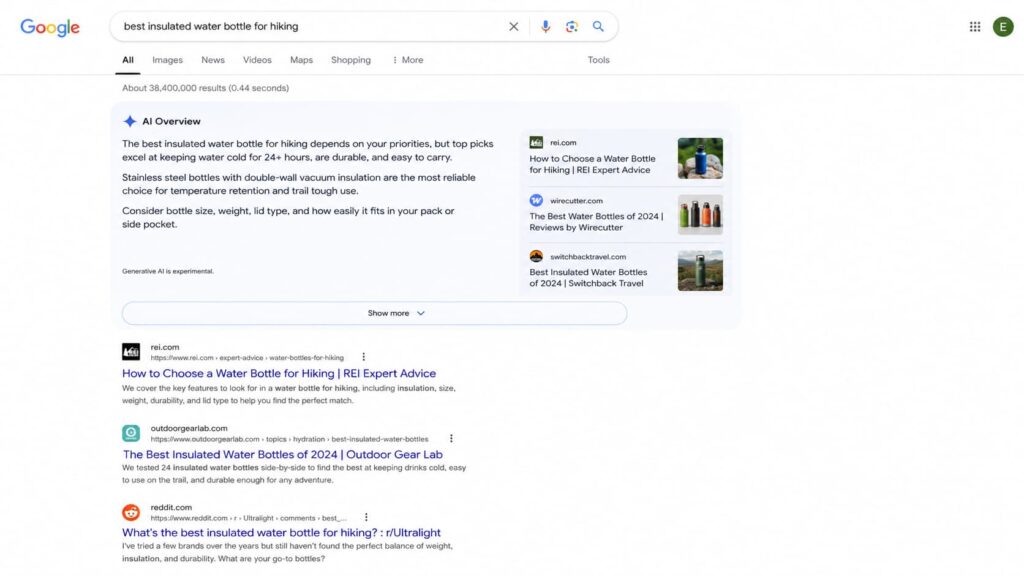
Here is the flow in plain terms. An AI search engine reads the intent behind a query, pulls from several sources at once, and synthesizes one answer. It favors sources with clear, well-defined entities and visible authority over pages that simply repeat the keyword.
You see this on Google AI Overviews and AI Mode, and in assistants like ChatGPT and Perplexity, which answer directly and cite a handful of links instead of returning a long list.
The optimization consequence is blunt: if your content is not easy to extract, you can rank and still get skipped. The click math shows why this matters. A behavioral study of real Google searches found people clicked a traditional result only 8% of the time when an AI Overview was present, compared with 15% when it was not, and zero-click searches rose from 54% to 72% on triggered queries (Pew via Search Engine Journal). When the answer is on the page, being the quoted source is often the only visibility left.
Two sides of “AI for SEO”: doing SEO with AI vs. optimizing for AI
The phrase “AI for SEO” hides two very different jobs. One is using AI to do your SEO work faster. The other is optimizing your site so AI systems pick it. Most guides only cover the first. You need both, and the second is where the new advantage lives.
Using AI to speed up your SEO workflow
AI is a genuine time-saver on the production side. Common, safe uses include:
- Keyword research and clustering.
- Drafting content outlines.
- Writing first-pass meta titles and descriptions.
- Analyzing competitor pages.
- Spotting content decay across an aging site.
One rule keeps this from backfiring: language models invent facts and cite sources that do not exist. Google does not penalize AI-generated content by default, it penalizes unhelpful content however it was made (Google Search Central). So fact-check everything before it ships. AI amplifies a strong foundation. It does not fix a weak one.
Optimizing your site so AI engines cite you
This is the side competitors skim. To become a source an AI wants to quote, focus on a short list: write self-contained answers that make sense on their own, use a logical heading structure, define your entities clearly (products, brand, author), and build authority (E-E-A-T, the experience, expertise, authoritativeness, and trust signals Google weighs).
Then remove the guesswork for the machine. That last step is structured data, and several WordPress plugins add it, Schemafy among them. It is the bridge from “good content” to “content a machine can parse without ambiguity.”
Why structured data is the foundation of AI SEO
Structured data (also called schema markup, written as JSON-LD) is a set of labels that tell a machine what each part of your page means: this is a product, this is its price, this is a review, this is the author. It helps Google understand the page and can make it eligible for rich results (Google Search Central).
One honest caveat up front. Google states plainly that there is no special schema markup you need to add to appear in AI features like AI Overviews and AI Mode (Google Search Central). Schema is not a magic switch for AI citations, and anyone who tells you otherwise is selling something.
So why call it a foundation? Because the correlation is hard to ignore, and the mechanism is sound.
Industry studies in 2026 report that roughly 65% of pages cited by Google’s AI Mode and about 71% of pages cited by ChatGPT include structured data. Correlation, not a Google requirement, but a strong signal.
The mechanism behind that pattern: schema removes ambiguity. A machine reading raw HTML has to guess what your price, rating, and product name are. A machine reading JSON-LD does not guess. That same markup also earns rich results, which hold click-through rates up even as AI answers spread. If you want the full walkthrough, see our guide on how to use schema markup.
The schema types that matter most for ecommerce
If you run a store, a few schema types carry most of the weight:
- Product: name, brand, SKU, GTIN, and images, so the machine knows exactly what you sell.
- Review and its AggregateRating property: the star ratings and sentiment AI systems use to gauge trust.
- FAQ (
FAQPage): question-and-answer blocks that map cleanly to how AI answers. - Breadcrumbs (
BreadcrumbList): the navigation path that shows site hierarchy.
You do not have to hand-write these. Schemafy generates several of them, Product, Review, FAQPage, and BreadcrumbList, on WordPress and WooCommerce sites without touching code. You can also spin up JSON-LD manually with a free schema markup generator if you only need a page or two.
An AI SEO checklist you can act on this week
You will not run a month-long audit, so here is the tight version. Work top to bottom.
- Audit the structured data your pages already output.
- Add Product, Review, and FAQ schema where it fits.
- Write self-contained answers of 40 to 55 words under clear headings.
- Structure every page with a logical H1-to-H3 hierarchy.
- Strengthen entity and author information, who wrote this and why to trust it.
- Earn mentions from sites the AI models already trust.
- Track when your pages show up in AI Overviews and ChatGPT answers.
- Validate your JSON-LD so it has no blocking errors.
None of this promises a #1 spot in thirty days. It does make you the kind of source AI systems can read, trust, and quote. For the traffic side of the same work, see our playbook on how to increase organic traffic.
AI SEO mistakes that quietly kill visibility
Most AI SEO damage is self-inflicted and invisible until traffic dips. The common ones:
- Publishing AI content without fact-checking. Fix: verify every stat and source before it goes live.
- Broken or duplicate schema. Fix: validate your markup and keep one clean schema per page instead of three conflicting ones.
- Keyword stuffing instead of entities. Fix: write for concepts and clear meaning, not repetition.
- Ignoring extractability. Fix: lead sections with a direct, self-contained answer.
- Treating AI SEO as a replacement for technical SEO. Fix: it is a complement. Weak fundamentals sink both.
How Schemafy fits into your AI SEO stack
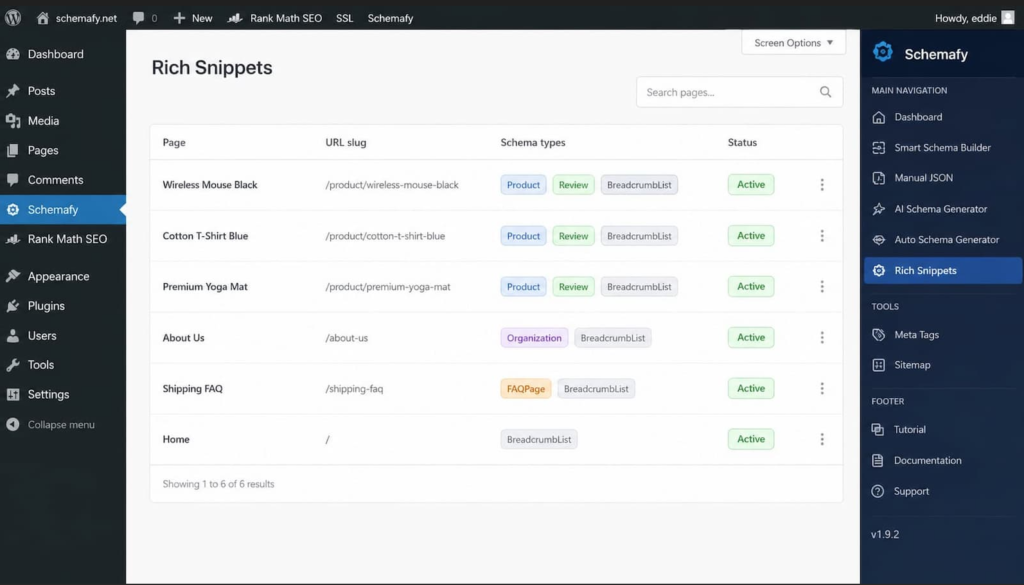
Keeping JSON-LD correct across a growing WordPress site is tedious and easy to get wrong, which is exactly where the mistakes above come from. Schemafy generates schema markup like Product, Review, FAQPage, and BreadcrumbList on WordPress and WooCommerce sites with no code, and its Rich Snippets screen lets you see and manage every schema you have applied in one place. The AI SEO payoff is simple: cleaner, machine-readable pages that AI systems can extract without guessing.
Frequently asked questions about AI SEO
Short answers to the questions people ask most.
Does AI SEO really work?
Yes, when it builds on solid fundamentals. AI amplifies strong content but will not fix a weak site. Pages built for AI search do get cited more often: industry studies find the majority of pages quoted by AI Mode and ChatGPT include structured data, though that is correlation, not a guarantee.
Is AI-generated content bad for SEO?
No. Google does not penalize AI-generated content itself, it penalizes unhelpful, spammy content however it is made. AI drafts work for SEO when they are fact-checked, edited for accuracy, and genuinely useful. Publishing unverified AI output risks errors that damage credibility and rankings.
What is the difference between AI SEO and GEO?
GEO (Generative Engine Optimization) is a subset of AI SEO focused on earning citations in generative answers like ChatGPT and Google AI Overviews. AI SEO is the broader practice of staying discoverable and trusted across all AI-powered search. The underlying tactics overlap almost entirely.
How do I get my products cited by ChatGPT?
Make your product data machine-readable. Add Product, Review, and FAQ schema so an AI can read price, availability, and ratings without guessing, and write clear, self-contained product descriptions. Structured data is the highest-impact first step, since a large share of ChatGPT-cited pages include it.
Do I need schema markup for AI search?
Not strictly. Google says there is no special schema required to appear in AI Overviews or AI Mode. But structured data correlates with being cited and earns rich results, so it is one of the highest-impact things you can do, even if it is not a formal requirement.
Final thoughts
AI SEO is not a new discipline bolted onto the old one. It is the same fundamentals, aimed at a reader that now summarizes instead of listing, where being extractable and citable matters as much as ranking.
The fastest first step is to see what structured data your pages emit today, then fill the gaps on your most important products and pages.
Does your site already have Schema Markup?
Generate structured data by template, with AI or in bulk, and verify it with Google's Rich Results Test — all from WordPress, no code.
- ✓ 16 schema types
- ✓ Free plan, forever
- ✓ Keeps Yoast / Rank Math
Eddie Casas built the first version of Schemafy himself, rough and vibe-coded, to fix a problem he kept hitting in his own SEO work: structured data that took too long to do right. Once the idea proved out, he brought in engineer Fabián Tinjacá to rebuild it into the plugin it is today. He now leads growth, SEO and content at Schemafy, and runs QA on every release before it ships. He is also the founder of TheBaseo, an SEO and AEO agency, so the playbooks on this blog are the ones he runs on real sites, not theory. His take: most schema advice online is written by people who have never had to apply it across hundreds of live pages. Eddie writes for the operator who has.