
The Best Generative Engine Optimization Tools in 2026

One of your clients emails: “Why don’t we show up when I ask ChatGPT for a recommendation?” Now multiply that across 10 or more sites you manage. Generative engine optimization (GEO) is the work of getting your content cited inside AI answers from ChatGPT, Gemini, AI Overviews, Perplexity, Copilot, and Claude. It matters because roughly 60% of searches now end without a click to any external site (Semrush, 2025). This guide sorts the tools by job, not by a flat ranking.
In this guide:
- [What Are Generative Engine Optimization Tools?](#what-are-generative-engine-optimization-tools)
- [How We Categorized the Tools](#how-we-categorized-the-tools)
- [Category 1: AI Visibility & Mention Tracking Tools](#category-1-ai-visibility–mention-tracking-tools)
- [Category 2: GEO Content Creation Tools](#category-2-geo-content-creation-tools)
- [Category 3: Structured Data & Technical GEO Tools](#category-3-structured-data–technical-geo-tools)
- [Free GEO Tools Worth Trying](#free-geo-tools-worth-trying)
- [How to Choose the Right GEO Tool for Your Stack](#how-to-choose-the-right-geo-tool-for-your-stack)
- [GEO Tools Comparison Table](#geo-tools-comparison-table)
- [Build Your AI Search Foundation with Schemafy](#build-your-ai-search-foundation-with-schemafy)
- [Frequently Asked Questions](#frequently-asked-questions)

Caption: For an agency, GEO is a portfolio problem: every client site needs to be readable, trackable, and citable by AI engines.
What Are Generative Engine Optimization Tools?
Generative engine optimization tools help your brand get mentioned and cited inside AI-generated answers. They monitor how large language models like ChatGPT, Gemini, and Perplexity reference you, guide content so it is easier to quote, and structure your pages so AI engines can read and trust them.
That covers three distinct jobs. The first is measurement: tracking your share of voice and citations across AI engines and AI Overviews. The second is creation: shaping content so an LLM is more likely to pull it into an answer. The third is the technical layer: the structured data that tells an engine what your page actually says.
Here is the one-line difference between the two disciplines. SEO optimizes for algorithmic page ranking. GEO optimizes for being synthesized into the answer itself. If you want the longer version, we cover it in our primer on generative engine optimization.
How We Categorized the Tools
Most GEO listicles stop at one category: mention trackers. They tell you whether an AI cites you, then rank a dozen of them by price. That leaves out the layer that decides whether an AI can read your content in the first place.
So we split the market into three:
- Measure tools track your visibility inside AI answers.
- Create tools help you produce content an LLM wants to cite.
- Structure tools build the technical layer, the schema markup and structured data AI engines consume.
For an agency running 10 or more client sites, knowing which category your problem lives in is what stops you from paying for the wrong tool.
Category 1: AI Visibility & Mention Tracking Tools
These tools answer one question: is the AI citing me, and for which prompts? They run large sets of prompts across engines and report where your brand shows up, how often, and in what tone.
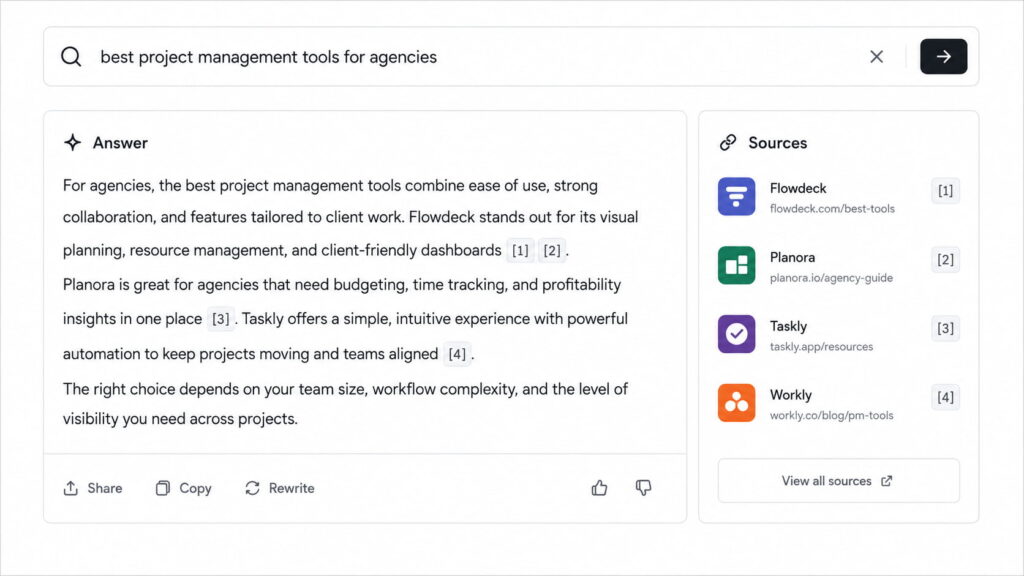
Caption: AI answer engines cite a handful of sources per response, so tracking whether you are one of them is the core job of Category 1.
Profound
Profound is built for enterprise teams that need real interaction data across the full field of AI engines. It captures how your brand appears across 10 or more engines, including ChatGPT, Claude, Perplexity, Gemini, Copilot, and Google AI Overviews, and was named a Leader in G2’s Winter 2026 AEO category (Profound).
Best for: large in-house teams and enterprises. Key features: cross-engine mention tracking, sentiment, and the specific prompts that trigger your brand. Pricing: custom, enterprise-tier.
SE Ranking
SE Ranking is the most complete pick because it folds AI visibility into a full-stack SEO platform instead of selling it as a standalone. You can map AI citations back to the same keyword rankings and backlinks you already track, which is exactly what an agency wants when it reports to a client.
Best for: teams that want SEO and GEO in one tool. Key features: AI visibility across six engines (AI Overviews, AI Mode, ChatGPT, Gemini, Perplexity), tied to rank tracking and backlinks. Pricing: from $52/mo, with AI tracking included in the Pro plan (around $95/mo).
Semrush AI Toolkit
Semrush tracks brand mentions across ChatGPT, Google AI Mode, AI Overviews, Gemini, and Perplexity, drawing on a database of more than 289 million prompts (Semrush). If your agency already lives inside Semrush, the toolkit slots into a workflow your team knows.
Best for: teams already on Semrush. Key features: mention tracking, share of voice, and sentiment across five engines. Pricing: $99/mo per domain, added on top of a Semrush plan.
Otterly (budget pick)
Otterly.ai is the entry-level option. It tracks citations and URLs across ChatGPT, Gemini, and Perplexity without the depth or price of an enterprise platform, which makes it a clean starting point.
Best for: solopreneurs and small businesses starting out in GEO. Pricing: from $29/mo. This is the budget pick on the list.
Category 2: GEO Content Creation Tools
These tools help you write content an AI is more likely to pull into an answer. They sit closer to your editorial workflow than to your analytics.
Writesonic
Writesonic combines AI-assisted writing, SERP research, and optimization workflows aimed at raising the odds your content gets cited or included in an AI response. For an agency producing volume across many client sites, that consolidation matters.
Best for: content teams working at scale. Pricing: from $16/mo, with team plans starting around $99/mo.
Surfer / MarketMuse
Surfer optimizes content against target keywords, competitors, and brand voice, so a draft ships with the on-page signals already in place. MarketMuse takes the planning angle: it identifies the topic areas where you can realistically build authority. Read together, one tunes the page and the other picks the battles, and both pair well with getting your meta descriptions right.
Best for: on-page optimization (Surfer) and topical authority planning (MarketMuse). Pricing: Surfer from $89/mo; MarketMuse offers a free tier plus custom plans.
Category 3: Structured Data & Technical GEO Tools
Here is the gap the rest of the market skips. Tracking tools tell you whether you appear in AI answers. They do nothing about why you appear, or why you don’t.
LLMs lean on structured data because it lowers the cost of interpreting meaning and reduces the risk of hallucinating what a page is about. Plain prose forces the model to guess. Schema markup hands it the answer in a format built for machines. That is the job of this category, and it is where a WordPress schema plugin like Schemafy operates.
Schemafy
Schemafy is a WordPress plugin that generates and manages the schema markup, the JSON-LD, that AI engines read when they decide what your page is about. Instead of hand-writing markup for hundreds of pages, you scan a site and apply structured data at scale.
Best for: sites that want their content to be readable and citable by AI engines through clean JSON-LD. Key features: schema generation for the types that matter for AI search (Article, Product, FAQPage, Organization, HowTo, LocalBusiness), JSON-LD validation, and coverage across many pages at once.
The workflow is direct. Open Schemafy → Auto Schema Generator, click Scan Site, and filter by post type to find pages missing schema. Then open Schemafy → AI Schema Generator, select a page and a type such as Article or Product, click Generate Schema with AI, and click Save to Website. If you prefer to check the output by hand, you can validate your JSON-LD before it ships. For the wider picture, see our guide on how to use schema markup for SEO and AI search.
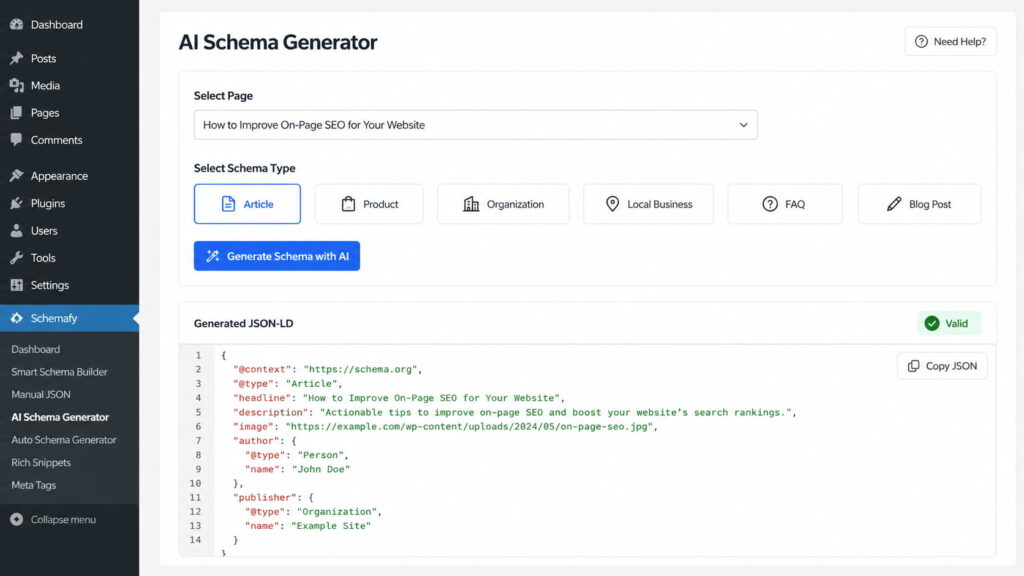
Caption: Schemafy generates and validates JSON-LD per page, so structured data ships across a whole site without hand-coding each one.
Why Schema Markup Is the Foundation of GEO
This is not a vendor claim. In April 2025, Google stated that structured data gives an advantage in search results, and in March 2025 Fabrice Canel of Microsoft Bing confirmed that schema markup helps Copilot’s LLMs understand content (Search Engine Land).
The logic is simple. Without schema, an engine infers your page’s meaning from context, and inference is where errors and hallucinations creep in. With schema, you state it outright: this is a product, this is its price, this is the author, this is the FAQ. JSON-LD is the format recommended by Google and defined by Schema.org, which means it is the same language both classic search and AI engines already parse.
That order matters. A tracker that reports you are invisible in AI answers cannot fix the reason you are invisible. The structured layer comes first. Measurement comes after there is something structured to measure.
“Structured data gives an advantage in search results.” Google, April 2025. Microsoft’s Fabrice Canel confirmed the same month that schema helps Copilot’s LLMs understand content.
Free GEO Tools Worth Trying
Before you commit budget, audit where you stand. A few tools cost nothing and give you a baseline:
- HubSpot AI Search Grader grades how your brand shows up in AI answers.
- Mangools AI Search Grader runs a lightweight visibility check across engines.
- Schemafy’s free schema markup generator builds valid JSON-LD without code.
- A SERP preview tool shows how your title and description render before you publish.
Treat these as your first pass. They tell you whether you have a visibility problem, a content problem, or a structure problem, which points you at the right paid category next.
How to Choose the Right GEO Tool for Your Stack
Match the tool to the bottleneck, not to the hype.
If you already run a full SEO stack and just need to see your AI footprint, add a visibility layer. SE Ranking suits teams that want it inside their existing rank tracking; Semrush suits teams already in that ecosystem.
If your bottleneck is production, and you cannot ship citable content fast enough across client sites, the answer is a creation tool like Writesonic or Surfer.
If you appear rarely or inconsistently in AI answers, the problem is usually upstream: the engine cannot read your pages cleanly. Fix the technical layer with schema first. That same discipline underpins how you increase organic traffic in classic search, so the work pays off twice.
The practical rule: measure, but first make sure there is something structured to measure.
GEO Tools Comparison Table
| Tool | Category | Best For | AI Engines Covered | Starting Price |
|---|---|---|---|---|
| Profound | Tracking | Enterprise teams | 10+ (ChatGPT, Claude, Perplexity, Gemini, Copilot, AI Overviews) | Custom |
| SE Ranking | Tracking + SEO | SEO and GEO in one | 6 (AI Overviews, AI Mode, ChatGPT, Gemini, Perplexity) | From $52/mo |
| Semrush AI Toolkit | Tracking | Teams on Semrush | 5 (ChatGPT, AI Mode, AI Overviews, Gemini, Perplexity) | $99/mo per domain |
| Otterly.ai | Tracking (budget) | Solopreneurs | ChatGPT, Gemini, Perplexity | From $29/mo |
| Writesonic | Content creation | Content teams at scale | ChatGPT, Perplexity (research) | From $16/mo |
| Surfer | Content creation | On-page optimization | Content layer | From $89/mo |
| MarketMuse | Content creation | Topical authority | Content layer | Free tier; custom |
| Schemafy | Structured data | Citable content via JSON-LD | Engine-agnostic (all read schema) | Freemium |
| AI Search Grader | Free audit | A first visibility check | ChatGPT and others | Free |
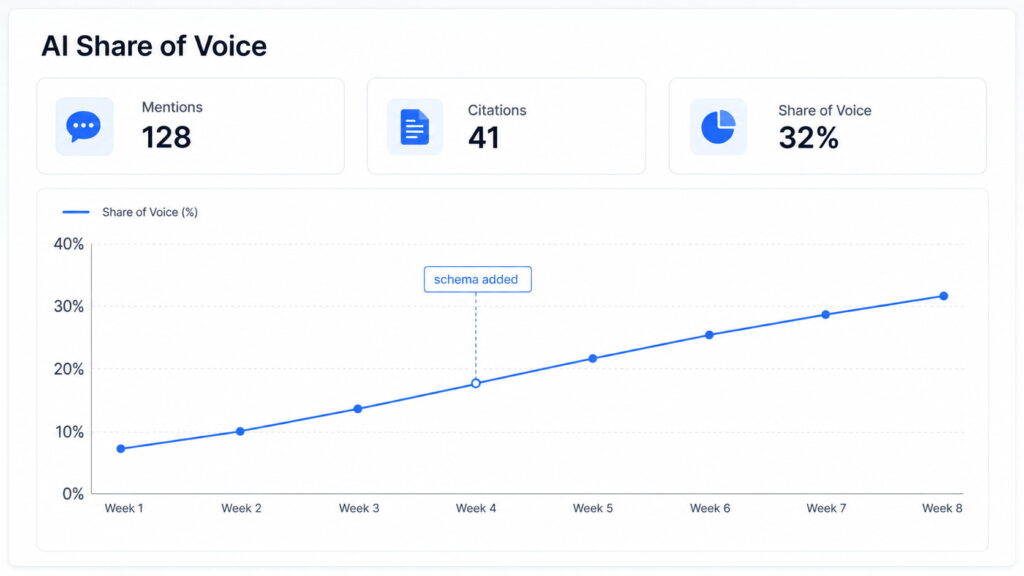
Caption: Visibility trackers show the score. The structured data layer is what actually moves it.
Build Your AI Search Foundation with Schemafy
The trackers on this list tell you the score. They cannot change it. Winning share of answer means building the structured data layer that AI engines read and cite, and that is the part Schemafy handles: clean JSON-LD across your pages, generated and validated without hand-coding each one.
If your content is not showing up in AI answers, start where the engines actually read: your structured data. Audit what your pages are missing, generate the schema, and give every AI engine a page it can quote with confidence.
Does your site already have Schema Markup?
Generate structured data by template, with AI or in bulk, and verify it with Google's Rich Results Test — all from WordPress, no code.
- ✓ 16 schema types
- ✓ Free plan, forever
- ✓ Keeps Yoast / Rank Math
Frequently Asked Questions
What is the best generative engine optimization tool?
There’s no single best GEO tool. It depends on the job. For AI visibility tracking, SE Ranking and Profound lead; for content, Writesonic; for the technical structured-data foundation that makes content citable by AI, Schemafy. Most teams combine one tracker with a schema layer.
Do I need a separate tool for GEO or is SEO enough?
SEO and GEO work together, but SEO tools alone don’t show whether AI engines cite you. GEO tools track brand mentions across ChatGPT, Gemini, and Perplexity, and help structure content so LLMs can trust and quote it. You need both.
Are there free generative engine optimization tools?
Yes. Free GEO tools like AI Search Grader and HubSpot’s AEO Grader evaluate how your brand appears in AI answers, and free schema generators create basic JSON-LD. They’re good for auditing, but paid tools add continuous tracking and scale.
Does schema markup help with generative engine optimization?
Yes. AI engines prioritize structured data because it reduces the work of interpreting meaning and lowers hallucination risk. Google (2025) confirmed structured data gives an advantage, and Microsoft confirmed schema helps Copilot’s LLMs understand content, making pages easier to cite.
How do GEO tools measure AI visibility?
GEO tools run large sets of prompts across AI engines and track whether your brand is mentioned, cited, or linked. They report share of voice, sentiment, and which prompts trigger your brand, some drawing on databases of hundreds of millions of prompts.

Fabián Tinjacá is the CTO of Schemafy and the engineer who turned an early prototype into a production plugin. He owns the technical side end to end: the plugin core, the schema generation engine, releases, and bug fixes. He also built the Schemafy website in Astro. His take: most WordPress SEO plugins are slow because they try to be five tools at once. Fabián builds Schemafy to do structured data and meta well without dragging down the sites it runs on.