
What Is Off-Page SEO? The Signals That Build Authority Off Your Site

Most WordPress SEO advice assumes that if you fix everything you control, you win. Clean titles, valid schema, fast pages, sensible internal links. Do that across every client site and the rankings follow.
They often don’t.
Google and the AI systems now summarizing it both weigh something you cannot edit: what the rest of the web says about you.
That is off-page SEO. This guide covers what it actually is, how it differs from on-page and technical work, the six signals that carry weight, the step almost every guide skips, which techniques still work, what gets you penalized, how to measure it, and a 90-day plan you can start this week.
What is off-page SEO?
Off-page SEO is everything that happens away from your own website to build its authority, trust, and relevance: backlinks, brand mentions, reviews, business listings, authorship signals, and community presence. It is the half of SEO you influence but do not directly control.
The most common mistake is treating off-page SEO and link building as the same thing. Links are one signal out of six. Reviews on third-party platforms, mentions with no link attached, directory listings, who your authors are, and where your brand shows up in video and community discussion all feed the same judgment.
You will also see this called off-site SEO or off-page optimization. Same discipline, different labels.
The idea goes back to PageRank, which treated a link as a third-party recommendation rather than a claim the site made about itself. Everything in this article is a descendant of that one assumption: a recommendation you did not write about yourself is worth more than one you did. Semrush’s guide frames it the same way.
Off-page SEO vs. on-page SEO vs. technical SEO
| On-page SEO | Technical SEO | Off-page SEO | |
|---|---|---|---|
| What it is | What you say about yourself | How easily you can be read | What others say about you |
| What you control | Full | Full | Influence only |
| Examples | Content, headings, internal links, meta tags, structured data | Crawlability, speed, indexation, canonicals | Backlinks, brand mentions, reviews, listings, video |
| How fast it moves | Days to weeks | Days to weeks | Months |
That is the whole distinction in one line: on-page is what you say about yourself, technical is how easily you can be read, off-page is what others say about you.
The three do not compete. Off-page authority with no on-page substance sends visitors to a page that cannot convert them, and it gives search engines nothing specific to rank. On-page work with no off-page signal produces a well-built page that nobody vouches for.
Most operators overweight the first two because they are the ones you can finish. You can fix common SEO issues, rewrite URL slugs, and check every title in a SERP preview in an afternoon. Off-page never gets finished, which is exactly why it accumulates into a moat.
Why off-page SEO matters more in AI search
The stakes changed. Off-page signals no longer just decide where you sit in a list of ten blue links. They decide whether ChatGPT, AI Mode, and AI Overviews name you at all. In a generated answer there is no position four to fall back to. You are mentioned or you are absent.
Ahrefs studied 75,000 brands to see which factors track with being mentioned in AI answers. Across ChatGPT, AI Mode, and AI Overviews, YouTube mentions showed the strongest correlation at roughly 0.737, higher than any other factor tested. Branded web mentions came next at 0.66 to 0.71.
An earlier Ahrefs study focused on AI Overviews specifically put branded web mentions at 0.664 against 0.218 for number of backlinks. Roughly three times stronger, for a signal most teams do not budget for.
Two findings cut against common advice. In the cross-platform study, number of site pages correlated at about 0.194, which is close to nothing. Publishing more is not the lever. And Seer Interactive found the same pattern independently, with domain rating at 0.25 and backlinks at 0.10, so this is not one vendor’s dataset talking.
Now the part most articles quoting these numbers leave out.
Ahrefs published a caveat with both studies. “The usual disclaimer applies: correlation isn’t causation,” the cross-platform study says. “We’ve spotted patterns between search metrics and AI mentions, but that doesn’t mean improving these metrics will automatically boost your AI visibility.” That matters here more than usual, because a brand that is genuinely well known accumulates YouTube mentions, web mentions, and branded searches at the same time, without any of them causing the others. The methodology tightens the point: both studies filtered for domains with a domain rating above 40 and a top keyword doing at least 800 searches a month, which selects for brands that already arrived.
Read the numbers as a description of what visible brands look like, not as a set of dials. The practical takeaway survives either way, and it lines up with what generative engine optimization work has been pointing at: presence across other people’s properties is what these systems draw on.
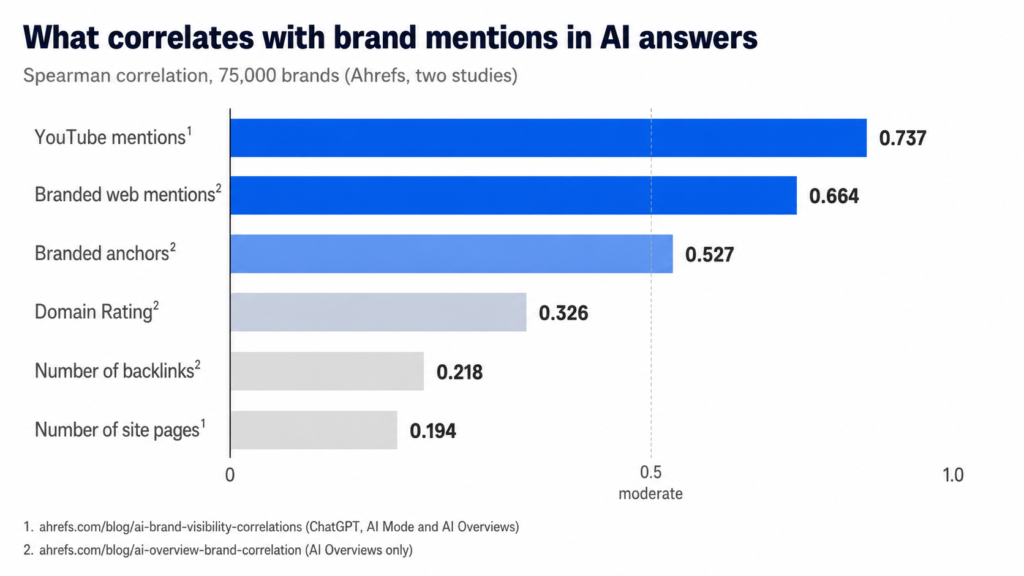
Caption: Mention-based signals outrank link-based signals in every dataset published so far. Ahrefs cautions that these are correlations, not levers.
The 6 off-page SEO signals that actually count
These are ordered by how much difference they make for a site that still has to earn its authority, not one that already has a household name. A recognized brand can skip most of this list. Everyone else cannot.
1. Backlinks
A backlink is a link from another website to yours. It is the oldest off-page signal and still the most discussed, though no longer the most powerful.
Relevance and quality beat volume, and it is not close. A handful of links from sites that cover your subject will do more than hundreds from unrelated directories. What separates a good link from a bad one:
- Topical relevance. The linking page covers a subject adjacent to yours.
- Domain authority. The linking site has earned its own credibility.
- Real traffic. The specific page linking to you has readers, not just a URL.
- Natural anchor text. The visible link text reads like something a human wrote.
- Editorial placement. The link sits inside the body content, not in a footer or a sidebar widget.
That fourth point has data behind it now, and it inverts what classic link building teaches. Branded anchors, meaning link text containing your brand name, correlated with AI visibility at 0.628 in AI Mode and 0.527 in AI Overviews. Number of backlinks sat at 0.218. Being linked to by name outperforms being linked to with a keyword you picked.
Three ways to earn links without a PR team: publish original data other people need to cite, offer expert commentary to trade publications covering your sector, and get listed on the resource pages your industry associations already maintain. All three are slow. None of them require buying anything.
2. Brand mentions (linked and unlinked)
A mention with no link still counts. If three industry blogs, a Reddit thread, and a YouTube video name your company, search engines and language models learn two things: that you exist, and what category you belong to.
Unlinked mentions, text written about your brand on other websites, have very little impact on SEO, but a much bigger impact on GEO. LLMs derive their understanding of a brand’s authority from words on the page, from the prevalence of particular words, the co-occurrence of different terms and topics, and the context in which those words are used.
Ryan Law, Director of Content Marketing, Ahrefs
The volume effect is steep. Brands in the top quartile for web mentions averaged 169 AI Overview mentions. The quartile below averaged 14.
The actionable version is unlinked mention reclamation: search for places your brand name appears without a link, then ask for one. Half the time the writer simply forgot. One caveat that trips people up: content on your own domain is not a third-party mention. Writing about yourself does not count, no matter how much of it you publish.
There is a gap in that logic worth noticing. For any of this to accrue to you, something has to establish that the “Acme Analytics” in that Reddit thread is your Acme Analytics. Hold that thought.
3. Reviews and third-party reputation
For most sites in this audience, this means product and vendor reviews on platforms you do not own: software comparison sites, marketplaces, and the community forums where your buyers actually ask each other for recommendations.
Four things matter. Volume, because one review is an anecdote. Average rating, obviously. Velocity, because a steady trickle reads as a real business while forty reviews in one month and silence afterward reads as a campaign. And your response pattern, because how a company answers criticism is itself evidence about the company.
Do not buy reviews. Beyond the platform bans, it fails at the thing you wanted, since purchased reviews cluster in ways that are straightforward to detect.
Google’s search quality guidance points its evaluators toward independent sources when assessing a site rather than the site’s own claims about itself. That is the entire logic of off-page SEO stated as policy.
One distinction to keep straight, because it causes real confusion: reviews collected on your own site are first-party content, and they are what Review and AggregateRating structured data describe. Reputation on third-party platforms is off-page. Marking up the first does not improve the second. They are separate jobs.
4. Business listings and citations
If any of your sites represent a business with a physical location, this one applies. If not, skip it.
A citation is a mention of a business name, address, and phone number in a directory or listing. Consistency matters more than volume here. Mismatched address data across directories is one of the most common problems in this category and one of the easiest to fix, because it is clerical work rather than strategy.
LocalBusiness structured data on the site itself helps tie those external listings back to the business as a single entity, which is the same mechanism the next section covers in full.
5. Author and publisher signals
This is the signal with the most upside and the least attention among operators running many sites.
Search systems increasingly ask who wrote a page, what else that person has published, and whether the organization publishing it is a recognizable entity. Most WordPress installations answer all three questions with “admin.”
The fix is unglamorous and takes an afternoon per site. Give every author a real bio that links to verifiable profiles elsewhere. Keep author identity consistent across the sites where the same person writes, so the profiles resolve to one human rather than five strangers with the same name. Retire the generic account.
Person and Organization structured data are the machine-readable version of the same claim. The bio tells a reader who wrote this. The schema tells a parser the same thing without requiring it to guess.
6. Video, community, and social distribution
Likes are not a ranking factor. Distribution is where the value sits, because distribution produces links, mentions, and branded searches, and those are signals. This is the same distinction that applies to meta descriptions, which are not a ranking factor but still shape whether anyone clicks.
YouTube earns its own paragraph given that 0.737 figure. The likely mechanism is not mysterious. YouTube is among the most-cited domains in AI answers, and its transcripts are also training data. The New York Times reported that OpenAI trained GPT-4 on over a million hours of YouTube transcription. Video sits on both the input and the output side of these systems.
For a small team the realistic version is one video a quarter answering the question you already field on every sales call. Reddit and niche podcasts work on the same principle. Forum spam does not, and it is the fastest way to get a brand name associated with the wrong thing.
The entity layer: connecting off-page signals to your site
Every guide on this subject stops at the moment someone mentions you. That is where the interesting problem starts.
When a search engine or a language model encounters “Acme Analytics” on a site you do not control, it has to decide what that string refers to. Your company. A different company with a similar name. A product. A person. Nothing at all. Until that question resolves, the mention is text on someone else’s page, not authority attached to your business.
Organization structured data with the sameAs property is how you answer it explicitly. sameAs takes a list of URLs that unambiguously identify the same entity: your LinkedIn page, your Crunchbase profile, your Wikipedia entry if you have one, your directory listings, your YouTube channel. You are stating, in a format a parser reads without inference, that all of these are one thing and that thing is you. Person schema does the same job on author pages.
Now the honest part, because this section is where an article like this usually oversells.
Structured data does not create authority. It is not a ranking factor on its own, and adding sameAs to a site nobody mentions accomplishes nothing. What it does is make authority that already exists legible and attributable. It converts something a search engine would otherwise have to infer into something it can read. When the inference is easy anyway, because you are Nike, this changes little. When your brand name is generic, shared, or new, the inference is harder and the declaration does more of the work.
The practical audit takes twenty minutes per site. Does the site declare Organization schema at all? Is sameAs populated with real profiles, or empty? Do author pages carry Person schema, or just a WordPress bio field? For most client sites the answer to all three is no, which makes this the rare off-page problem you can fix without asking anyone else for anything.
Generating those types across a lot of pages without hand-writing JSON-LD is what schema generators are for, Schemafy among them, though a single Organization block on one site is quick enough to write by hand in any schema markup generator. If the underlying concepts are unfamiliar, our guide to structured data covers the vocabulary.
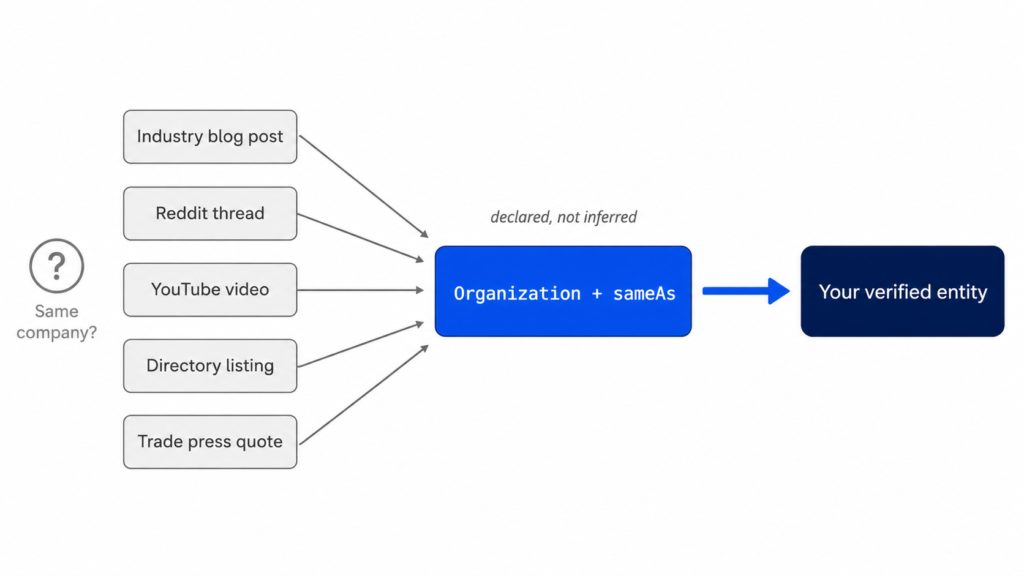
Caption: Off-page work creates the mentions. The entity layer helps make them attributable to you rather than to a similarly named stranger.
Off-page SEO techniques that still work
Ordered by how quickly they pay back for a small team, not by how impressive they sound in a strategy deck.
- Unlinked mention reclamation. Search your brand name, filter out your own domain, and email the writers who mentioned you without linking. Highest hit rate of anything on this list.
- Broken link building. Find dead links on resource pages in your niche, then offer your equivalent page as the replacement. You are solving the site owner’s problem, which is why it converts.
- Expert commentary for trade press. Answer journalist queries in your actual area of competence. One placement in a publication your buyers read beats ten guest posts nobody reads.
- Original research or proprietary data. Publish a number nobody else has. This is the only technique that earns links passively for years, and the only one that reliably takes a month of work before it returns anything.
- Resource page placement. Industry associations, alumni directories, and tool roundups maintain link lists. Ask to be on them.
- Genuine guest contributions. Write for publications you would read. Skip anything that advertises guest post slots, since that market is exactly what Google’s spam policies target.
- Creator collaborations. Partner with people who already have your audience’s attention. Their mention carries weight your own channel cannot manufacture.
- Real community participation. Answer questions in the forums and subreddits where your buyers gather, under a real name, without pitching. Slowest of all of these, and the hardest to fake.
The first two pay within weeks because they exploit work already done. The last two compound over quarters. Original research sits in between: expensive up front, then it keeps earning. Choosing which of these to run is a search intent question as much as a link-building one, since the goal is to be present where your buyers already look.
5 off-page SEO tactics that can get you penalized
- Buying links or using PBNs. Google’s spam policies name link schemes directly. Private blog networks get deindexed in batches, and you lose every link at once.
- Low-quality directory farms. Hundreds of listings on sites that exist only to list. They pass no value and establish a pattern that is easy to classify.
- Repeated exact-match anchor text. Two hundred links all reading “best project management software” is not a distribution any natural link profile produces. The pattern is the problem, not any single link.
- Buying reviews. Platform bans aside, review velocity and language similarity are both measurable, and the penalty tends to arrive as removal of every review you paid for.
- Duplicate or inconsistent listings. Less dramatic than the others, but conflicting business data creates ambiguity that suppresses you quietly rather than penalizing you loudly.
One nuance that gets lost: sponsorship is not a violation. Paying for a link becomes a problem when it passes ranking signals without disclosure, which is what rel="sponsored" and rel="nofollow" exist to prevent. Tag the link and the sponsorship is fine.
If you inherit a site with a questionable link history, audit the profile before assuming the worst. The disavow file exists for cases with a manual action or a clear pattern of purchased links, and Google has been consistent that most sites never need it. Reach for it last, not first.
How to measure off-page SEO
Six metrics, each with an obvious home:
- Referring domains and month-over-month growth (Ahrefs, Semrush). Growth rate tells you more than the absolute count.
- Link profile quality. Relevance and authority of what is pointing at you, not volume.
- Branded search volume. The cleanest available proxy for whether awareness is actually rising.
- Review volume and average rating across the third-party platforms your buyers check.
- Referral traffic (GA4). Which mentions send actual humans.
- Mention frequency in AI answers. How often you appear when a model answers a question in your category.
That last one needs a different mental model. In AI search, “position” barely means anything, since a generated answer is not a ranked list you can climb. You measure frequency of mention and share of voice against competitors instead. Answer engine optimization tools and AI visibility trackers exist specifically for this, and the category is young enough that methodologies still differ meaningfully between vendors.
Monthly is the right cadence. Off-page metrics move slowly enough that weekly checks produce noise and anxiety in equal measure. For a client report, three numbers carry the story: referring domains, branded search volume, and AI mention frequency.
A 90-day off-page SEO plan
Days 1 to 30: fix what you own. Roughly 8 to 12 hours. Audit the current backlink profile so you know what you inherited. Fix the entity layer: add Organization schema with a populated sameAs, give author pages Person schema, retire the “admin” byline. Correct listing inconsistencies where a site has a physical location. If you want to hand-write the markup, a JSON-LD editor is enough for a single organization block.
Days 31 to 60: claim what already exists. Roughly 12 to 16 hours. Run unlinked mention reclamation across every mention you can find. Publish one piece of original data, even a small one, drawn from something you already measure. Join one community where your buyers actually spend time and participate without pitching.
Days 61 to 90: build new surface. Roughly 10 to 14 hours. Pitch expert commentary to two trade publications. Record one video answering your most common sales question. Measure against the baseline from day one and adjust.
A word on expectations. Off-page work depends on other publishers, other platforms, and other people choosing to act, which is why it moves slower than anything you can change on your own server. It also compounds, because each mention makes the next one marginally easier to earn. This is a plan of actions, not a promise about a date.
Off-page SEO is a trust problem, not a link problem
On-page SEO is what you claim about yourself. Off-page SEO is what can be verified about you by someone else. The entity layer is what lets a machine match one to the other, and it is the piece almost nobody works on because it does not look like off-page work at all.
Before spending a quarter earning mentions, check whether your sites can even receive credit for them. If a search engine cannot tell that the company being discussed on someone else’s page is the company that owns your domain, those mentions are harder to credit to you.
Does your site already have Schema Markup?
Generate structured data by template, with AI or in bulk, and verify it with Google's Rich Results Test — all from WordPress, no code.
- ✓ 16 schema types
- ✓ Free plan, forever
- ✓ Keeps Yoast / Rank Math
Off-page SEO FAQs
Is off-page SEO the same as link building?
No. Link building is one part of off-page SEO, but not all of it. Off-page SEO also includes brand mentions, customer reviews, business listings, digital PR, author signals, video presence, and community participation. Anything that builds your reputation outside your own website counts as off-page work.
How long does off-page SEO take to work?
Most sites see measurable movement in three to six months. Off-page SEO depends on other websites, publishers, and customers acting, so it moves slower than on-page changes. Entity-layer fixes are the exception, since those are on your own site and can be shipped in a day.
Can I do off-page SEO myself?
Yes, especially the fundamentals. One person can audit a backlink profile, add Organization and Person schema, fix listing inconsistencies, and set up a mention-reclamation process in about ten to twelve hours. Sustained digital PR and link acquisition are the parts that are hard without dedicated time.
Do social media signals affect SEO?
Not directly. Likes and shares are not ranking factors. But social distribution creates the things that are: links, brand mentions, and branded searches. A post that reaches the right audience can earn coverage, which is what search engines and AI systems actually weigh.
What is the difference between on-page and off-page SEO?
On-page SEO covers what you control on your own site: content, headings, internal links, and page structure. Off-page SEO covers signals that live elsewhere: backlinks, reviews, listings, and brand mentions. On-page is what you claim about yourself; off-page is what others confirm.
How many backlinks do I need to rank?
There is no fixed number. It depends on how competitive your keyword is and how strong your competitors’ link profiles are. For most keywords, a handful of genuinely relevant links plus consistent brand mentions outperforms a large volume of low-quality links.
Does off-page SEO help with ChatGPT and AI Overviews?
Yes, and it may matter more there than in classic search. Ahrefs studied 75,000 brands and found YouTube mentions correlated with AI visibility at roughly 0.737, ahead of every other factor. In a separate study of AI Overviews, backlinks trailed brand mentions 0.218 to 0.664. Ahrefs notes correlation is not causation.
{
  "@context": "https://schema.org",
  "@type": "FAQPage",
  "mainEntity": [
    {
      "@type": "Question",
      "name": "Is off-page SEO the same as link building?",
      "acceptedAnswer": {
        "@type": "Answer",
        "text": "No. Link building is one part of off-page SEO, but not all of it. Off-page SEO also includes brand mentions, customer reviews, business listings, digital PR, author signals, video presence, and community participation. Anything that builds your reputation outside your own website counts as off-page work."
      }
    },
    {
      "@type": "Question",
      "name": "How long does off-page SEO take to work?",
      "acceptedAnswer": {
        "@type": "Answer",
        "text": "Most sites see measurable movement in three to six months. Off-page SEO depends on other websites, publishers, and customers acting, so it moves slower than on-page changes. Entity-layer fixes are the exception, since those are on your own site and can be shipped in a day."
      }
    },
    {
      "@type": "Question",
      "name": "Can I do off-page SEO myself?",
      "acceptedAnswer": {
        "@type": "Answer",
        "text": "Yes, especially the fundamentals. One person can audit a backlink profile, add Organization and Person schema, fix listing inconsistencies, and set up a mention-reclamation process in about ten to twelve hours. Sustained digital PR and link acquisition are the parts that are hard without dedicated time."
      }
    },
    {
      "@type": "Question",
      "name": "Do social media signals affect SEO?",
      "acceptedAnswer": {
        "@type": "Answer",
        "text": "Not directly. Likes and shares are not ranking factors. But social distribution creates the things that are: links, brand mentions, and branded searches. A post that reaches the right audience can earn coverage, which is what search engines and AI systems actually weigh."
      }
    },
    {
      "@type": "Question",
      "name": "What is the difference between on-page and off-page SEO?",
      "acceptedAnswer": {
        "@type": "Answer",
        "text": "On-page SEO covers what you control on your own site: content, headings, internal links, and page structure. Off-page SEO covers signals that live elsewhere: backlinks, reviews, listings, and brand mentions. On-page is what you claim about yourself; off-page is what others confirm."
      }
    },
    {
      "@type": "Question",
      "name": "How many backlinks do I need to rank?",
      "acceptedAnswer": {
        "@type": "Answer",
        "text": "There is no fixed number. It depends on how competitive your keyword is and how strong your competitors' link profiles are. For most keywords, a handful of genuinely relevant links plus consistent brand mentions outperforms a large volume of low-quality links."
      }
    },
    {
      "@type": "Question",
      "name": "Does off-page SEO help with ChatGPT and AI Overviews?",
      "acceptedAnswer": {
        "@type": "Answer",
        "text": "Yes, and it may matter more there than in classic search. Ahrefs studied 75,000 brands and found YouTube mentions correlated with AI visibility at roughly 0.737, ahead of every other factor. In a separate study of AI Overviews, backlinks trailed brand mentions 0.218 to 0.664. Ahrefs notes correlation is not causation."
      }
    }
  ]
}

Fabián Tinjacá is the CTO of Schemafy and the engineer who turned an early prototype into a production plugin. He owns the technical side end to end: the plugin core, the schema generation engine, releases, and bug fixes. He also built the Schemafy website in Astro. His take: most WordPress SEO plugins are slow because they try to be five tools at once. Fabián builds Schemafy to do structured data and meta well without dragging down the sites it runs on.